When conflict feels overwhelming, you don't have to face it alone.Mediation Services of Adams County provides affordable mediation and conflict-resolution services in Gettysburg and throughout Adams County, Pennsylvania.
MSAC helps people have difficult conversations, understand one another, and find a way forward—without taking sides or making decisions for them.
If you are curious about mediation or think we can help you, fill out our contact form and we will get back to you as soon as possible.

For couples going through divorce, mediation can help resolve important issues with less court involvement, lower costs, and more control over the decisions that affect their future. We can help you work through those decisions and put what you agree to into a clear divorce agreement.
For parents, whether married or not, we can help you create a co-parenting agreement that addresses schedules, holidays, communication, decision-making, expenses, and other issues that matter to your family.
Family mediation offers a safe, structured place for people to have difficult conversations outside of therapy or court. It can help parents, adult children, siblings, grandparents, and other family members work through conflict, changes in caregiving, communication problems, boundaries, living arrangements, or other issues that are straining relationships. A mediator helps everyone be heard, understand what matters most, and work toward practical agreements they can live with.
Inquire about mediation
Neighbor disputes, landlord-tenant issues, HOA conflicts, and small claims — community mediation helps people resolve everyday disagreements before they escalate.
Our community work also extends to protests, demonstrations, and public events. Through the Trust Network of Mediators Beyond Borders International, our trained mediators — recognizable by their green vests — help keep communication open, reduce escalation, and support constructive conversation when tensions run high.
Restorative justice focuses on repairing harm and rebuilding relationships rather than simply assigning blame or punishment. It gives those affected — including children who may have caused harm — a chance to understand the impact of what happened, take responsibility, and help decide what can be done to make things right. Restorative practices can be used in schools, neighborhoods, HOAs, community organizations, and other settings where people need to move forward together.
Inquire about mediation
Relationship mediation helps couples, family members, and others in close relationships work through conflict and improve communication — whether the goal is to stay together or to separate respectfully.
Unlike therapy, mediation focuses on specific issues and practical agreements. A neutral mediator supports both parties in expressing their concerns, understanding each other's perspectives, and finding a path forward that works for everyone involved.
MSAC provides practical training in mediation, communication, and negotiation skills for individuals, organizations, and community groups. Participants learn how to listen more effectively, respond when conversations become difficult, reduce escalation, and help people work through disagreement without taking sides or imposing solutions. Training can be tailored for workplaces, schools, boards, nonprofits, community organizations, and others who regularly navigate conflict.
Inquire about mediationMSAC offers lively, interactive presentations for businesses, organizations, schools, and community groups. Rather than a traditional lecture, we use games, real-life scenarios, and hands-on activities to explore communication, conflict, listening, and problem-solving. Presentations can be tailored to your group and are designed to be practical, engaging, and a little fun.
Inquire about mediationMediation is an alternative form of dispute resolution that allows people locked in conflict to resolve their issues peacefully. MSAC's transformative approach focuses on empowering individuals and fostering mutual understanding rather than simply pushing for a settlement.
And an Intake Coordinator will get back to you, learn more about your situation, and explain the process. Our online contact form is the best way to contact us.
The coordinator contacts the other party to explain mediation and confirm willingness to participate.
Qualified, neutral mediators guide the conversation. Each party shares their perspective in a safe, structured environment.
If an agreement is reached, the mediator can draft it for both parties. All notes are destroyed to protect confidentiality.
The mission of Mediation Services of Adams County is to promote peaceful coexistence in Adams County through the principles of mediation, recognition and acceptance of differences, and productive communication.
Mediation Services of Adams County Inc. (MSAC) transforms conflicts into opportunities for mutual understanding, social change, communication, and personal growth. MSAC, through collaborative efforts, raises public awareness of the value of mediation and alternative dispute resolution methods as vehicles for resolving personal differences and diminishing conflict in society at large.
Our organization is composed of people who are committed to alternative dispute resolution. We believe in dignity and respect for all people involved in a dispute. We believe that effective mediation can transform relationships, truly enabling life changes.
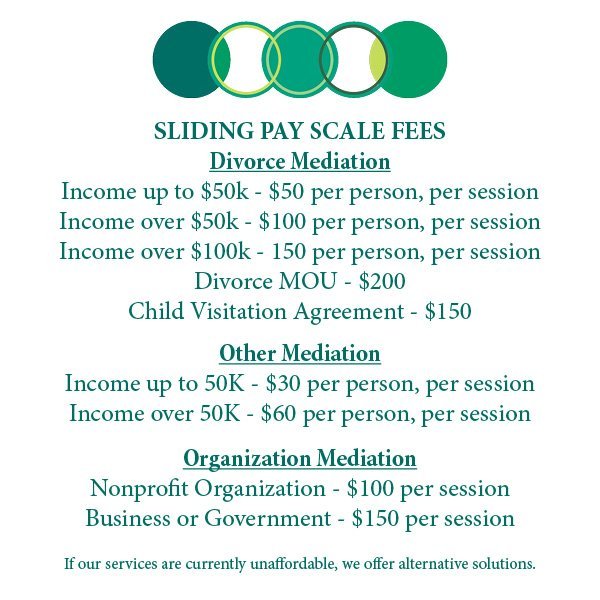
Our services are available to all regardless of socio-economic class, ethnicity or other considerations. While ability to pay is a secondary consideration, we believe that some investment by every participant is vital to a successful mediation. We will not knowingly put people at risk, either as participants or as mediators.
Mediation is an alternative form of dispute resolution that allows people locked in conflict to resolve their issues peacefully. To set up a mediation session, please fill out this form.
Every case is reviewed individually to determine whether mediation can be conducted safely and appropriately. We allow the participants to decide if mediation is right for them. Typical disputes equitably solved through mediation include family issues, landlord-tenant problems, neighborhood property issues, divorce and relationship issues. Conflict coaching is also available in instance where one party won't come to the table or an individual is unsure about how to move forward with a dispute.